
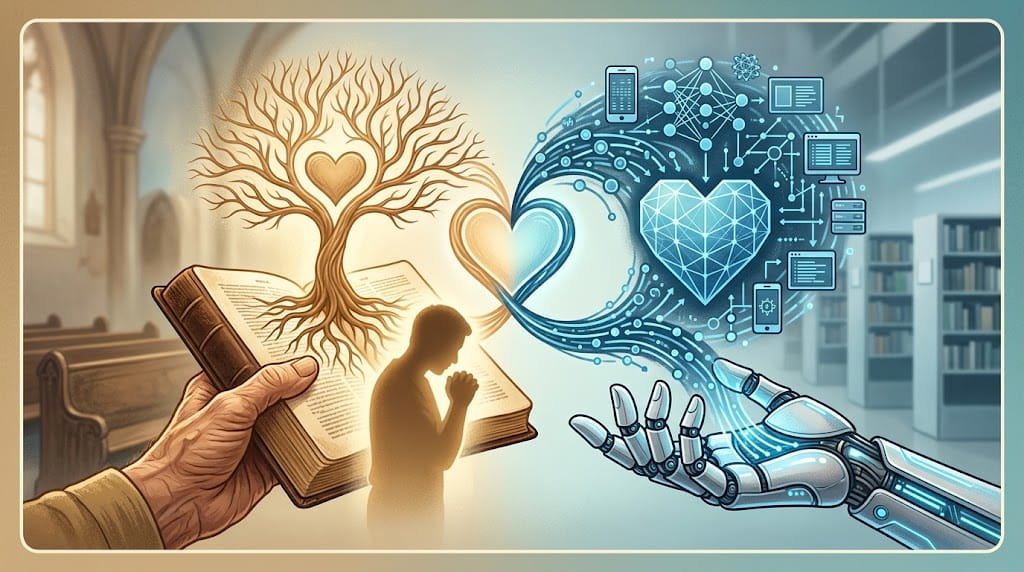
What we love is shaped by what we repeatedly do. That has always been the quiet work of formation—and it is precisely the work AI is now pressing on. As generative tools grow more capable, they do not just answer our questions. They train our habits, bend our attention, and slowly reshape what we want.
For Christians in the age of AI, the urgent question is not merely “Can I use this tool?” It is the deeper question: “What is this using me to become?”
The Quiet Work of Formation
Formation—becoming more like Christ—happens less in dramatic moments than in the accumulated small choices of daily life. What we attend to shapes us. What we desire, we pursue. What we pursue, we eventually become.
This is why the church has always taken habits seriously. Prayer, reading Scripture, fellowship, Sabbath rest: these are not optional extras. They are the means by which God forms our loves over time.
What AI Doesn’t Do For Us
In the conversation with pastor and linguist Michael Keller, one striking point emerges: AI offers the appearance of depth without the cost of it. (source)
That is true in ministry, in relationships, and even in our devotional lives. An AI can generate a polished prayer in a second. It cannot teach you to pray. It can produce a summary of a passage faster than you could read. It cannot form in you the love that comes from dwelling in the Word. It can simulate spiritual depth. It cannot grow it in you.
We are more than our outputs. We are not defined by efficiency, performance, or the ability to process information. The richer Christian vision of the human person is that we are beings made for God and for one another—formed slowly through love, relationship, and dependence.
Friction Is Not the Enemy
Modern tools are engineered to be frictionless, and that is precisely where the danger lies. The struggles that God uses to shape us are the very things AI offers to smooth away. Waiting, wrestling, uncertainty, and the humble labor of trying again—these are not obstacles to formation. They are its raw material.
If prayer, discipleship, and even thinking become effortless, something essential is quietly removed from our formation. We do not become deeper by bypassing the struggle. We become deeper by walking through it with God.
So the discipline of the Christian life in the AI age includes protecting small, deliberate moments of friction: reading a book you could have summarized, praying a prayer you could have generated, sitting in patient attention rather than instant output.
Training the Next Generation to Love Well
This is not only a question for adults. It is a question for the students we raise. A child who learns that every question has an instant answer, and every paper can be generated, is a child being formed by a certain picture of the world. The technology officer in the classroom, the AI in the pocket—these are all forming loves, whether we intend it or not.
That is why Bethel exists: to support educational initiatives that put Christian values and ethics at the center of learning. We want the conviction of Proverbs 9:10—“The fear of the Lord is the beginning of wisdom”—to shape not only what students know, but who they become. Wisdom, after all, is more than information. It is a rightly formed heart.
Formation is not a program. It is a life. In the age of AI, we get to choose what shapes our loves—before the tools choose for us.
Sources
- The Gospel Coalition — Silicon Spiritualities: AI and Formation: How Does AI Shape Our Loves? (with Michael Keller). Published July 20, 2026. thegospelcoalition.org/podcasts/silicon-spiritualities/ai-formation-shape-loves/
0 Comments